
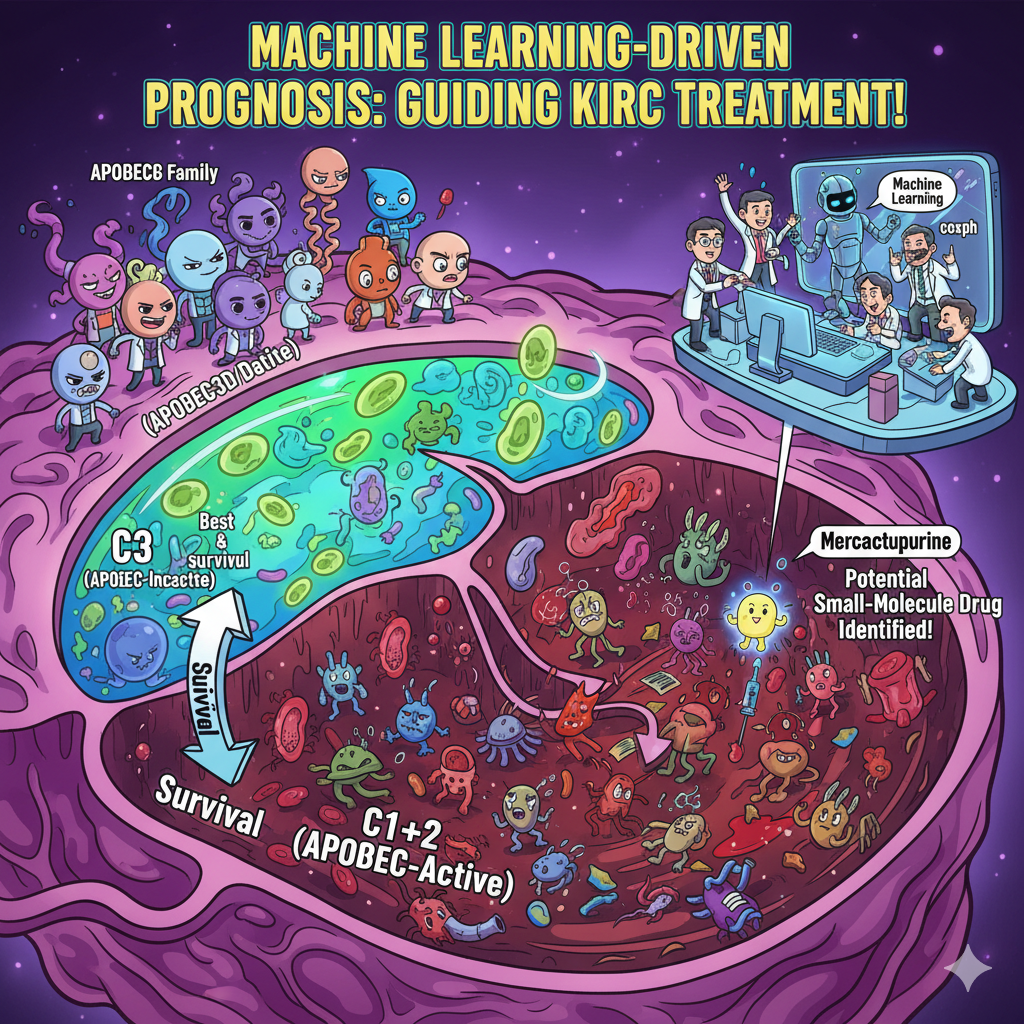
Bioinformatics pipelines have been steadily uncovering how APOBEC cytidine deaminases sculpt tumor genomes, yet their prognostic weight in kidney renal clear cell carcinoma (KIRC) remained cloudy. In this episode we unpack new work from Ren and colleagues that treats APOBEC signaling as a machine learning feature space, separating immune-inflamed from immune-desert tumors and forecasting therapy response.
Why APOBEC Signatures Matter in KIRC
The APOBEC family edits cytidine residues during immune defense but can introduce pervasive mutational signatures in tumors. Ren et al. show that APOBEC-enriched KIRC samples exhibit exhausted CD8+ T cells, skewed macrophage balance, and distinct epigenetic states, all of which converge on shorter survival. Parsing those signals helps flag patients who need aggressive follow-up or adjuvant strategies.
"APOBEC-driven immune and metabolic rewiring is a defining feature of high-risk KIRC, and learning-based stratification opens a path to actionable precision oncology," the authors write.
From Clustering to Predictive Modeling
Study Workflow at a Glance
Pan-Cancer Profiling
APOBEC copy-number variation and expression signatures were evaluated across 33 tumor types, highlighting KIRC as an APOBEC-high malignancy.
Consensus Clustering
Unsupervised clustering divided KIRC cases into APOBEC-active and APOBEC-inactive groups with contrasting immune infiltration patterns.
Machine Learning Stack
Random survival forests, survival SVMs, and Cox-based ensembles outperformed classical models, generating a consensus machine learning score for prognosis.
Therapeutic Guidance
The APOBEC score correlated with checkpoint inhibitor targets and nominated mercaptopurine as a repurposing candidate for immune-cold tumors.
Immune Landscapes and Metabolic Control
APOBEC-active clusters were flush with exhausted T cells and M2-skewed macrophages, while mitochondrial regulation genes hinted at metabolic stress. APOBEC score correlated positively with mtDNA replication machinery yet negatively with mtRNA stability, underscoring how editing enzymes reverberate through cellular energetics.
Key Talking Points in This Episode
- Mutational biology: How APOBEC-induced lesions reshape renal cancer evolution.
- Immune choreography: Why APOBEC-high tumors harbor exhausted T cells and altered macrophage polarization.
- Model selection: Survival SVMs and random forests versus traditional Cox regression for prognosis.
- Therapeutic implications: Using APOBEC scores to anticipate PD-1 inhibitor sensitivity and identify repurposable drugs.
- Data integration: Opportunities for multi-omics fusion to refine renal cancer risk models.
Takeaways for Precision Oncology
- APOBEC expression patterns provide a mechanistic lens on immune exhaustion and survival disparities in KIRC.
- Machine learning ensembles capture non-linear APOBEC effects and outperform classical models in forecasting patient outcomes.
- APOBEC-guided stratification could guide checkpoint blockade and inspire drug repurposing efforts in renal oncology.
Resources and Further Reading
License Attribution
This episode discusses research from: Ren, Z. et al. "Machine learning-driven classification and prognostic prediction of kidney renal clear cell carcinoma using APOBEC family expression signatures" Scientific Reports (2025). Licensed under CC BY-NC-ND 4.0.
Research Paper
Machine learning-driven classification and prognostic prediction of kidney renal clear cell carcinoma using APOBEC family expression signatures
Zhen Ren et al. • Scientific Reports • 2025
View on Publisher →